
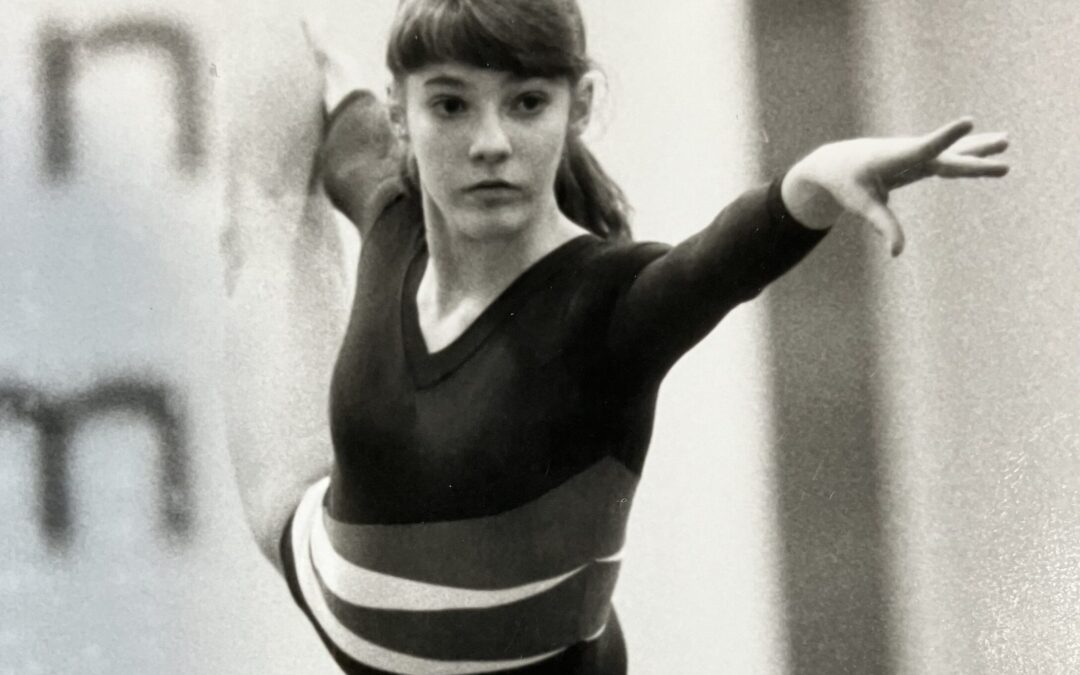
Growing up as a gymnast with a problem that had no name.
This post is part one of a series.
When I was growing up in sports in the ‘80s and early ‘90s, the only thing referred to as “abuse” was direct physical harm that left a mark, like a coach hitting or slapping an athlete. This was the only form of maltreatment that we knew was “off limits.” I suppose that’s because these were clear-cut cases with physical evidence. A coach grabbing an athlete by the arm, cornering them, and yelling at them was considered “intensity.” Sexual behaviors initiated by an adult coach toward a minor athlete were not particularly policed and might be normalized as a “relationship.” Any physically harmful coaching behaviors that did not include direct physical contact – like requirements to train on injuries, the denial of medical care (just ice it!), punishments by way of excessive conditioning (to the point of vomiting or collapse), the restriction of food, water, bathroom use or rest, requirements that athletes “do what it takes” to lose weight (without any nutritional guidance), requirements to perform dangerous skills without appropriate safety measures, being forced to overstretch to the point of a tear — were all par for the course.
Sure, there was physical evidence of harm in some of these examples, but if “no one was holding a gun to your head,” people assumed you must have consented to it. Subtlety of thinking surrounding uneven power relations between adult coaches who held all the cards and young athletes pursuing big dreams was not the strong suit of the sports world, nor really of popular culture at the time.
So, you can imagine that when it came to what we would now call emotional abuse, there was really no appropriate language or conceptual framework to describe it, though it was the most common form of harmful treatment we encountered. Being yelled at, insulted, humiliated, intimidated, threatened, coerced, and generally terrorized was treated as “just another day” in the gym. It was what you “had to deal with” if you wanted to participate.
Thirty years later, it is still the most common form of abuse that athletes encounter. The U.S. Center for SafeSport’s 2024 Athlete Culture & Climate Survey shows that 78% of athletes experienced behaviors related to emotional harm and neglect during their sports involvement. Because emotional abuse continues to go unrecognized, ignored, misunderstood, and tolerated, I’ve felt compelled to describe its patterns in hopes that struggling athletes out there know that they are not alone, that there is a name for what they have been subjected to, that it is not ok, and it is not their fault. My hope is also to help coaches and parents realize that emotional abuse is not just a form of “tough coaching” and, though it is common in sports, it does intense short- and long-term damage to the athlete and there is no justification for it.
To be clear, in my era not all coaches subscribed to such negative coaching behaviors (and I am grateful to have had some coaches who reminded me of what a human being deserves), but enough of them did that you could not escape it if you were in competitive (rather than recreational) sports for any length of time. Based on the statistics, things appear to be the same today.
Unspoken Principles of Authoritarian Coaching
The pervasive coaching regime, which I’d now call “authoritarian,” embodied a few key unspoken principles: The coach is always right and entitled to treat you in any way they see fit. The coach is entitled to have you do with your body anything he or she demands, even if it is dangerous, scary, painful, or injurious. As long as you’re on their team, the coach owns you — and you better be grateful, because there are plenty of kids waiting to take your place. Ruling by fear is the most effective way for a coach to control athletes and raise their performance level. The athlete must obey all orders or be punished. Nearly all forms of punishment are legitimate, including those that cause more fear, danger, and injury. Punishment is a form of “discipline” or “motivation.” The athlete should take it without complaint. Complaint of any kind is a sign of weakness, disloyalty, or insubordination, as is any show of pain or fear. As an athlete, you should be stoic and silent. And, you should be ready and willing to sacrifice everything to become a champion, including your body, your relationships outside of the sport, your sanity, your childhood, and your happiness. If not, you’re not committed enough.
If the coach’s orders, actions, or general belief system ever seemed unreasonable, unrealistic, ineffective, unwise, unsafe, unjust, or generally damaging, you’d better “suck it up.” There was no recourse for feedback, dialogue, negotiation, or change. The message was: If you can’t deal with it, you’re not tough enough to handle the pressures of the sport.
Coping With a Problem That Had No Name
As young athletes who wanted the chance to participate in the sports we had fallen in love with and excelled at in healthier training environments, we tried our best to cope with it. We were no strangers to hard work, and had been expected to strive for perfection – pointed toes and stuck landings — for years. We were already strong and disciplined kids, but nothing prepared us for the “big change” that came with the entrance of the authoritarian coach.
In my sport of gymnastics, the onset of the new “treatment” (for which we had no appropriate name) coincided with facing, for the first time, significant fears surrounding the advanced skills we were learning. Fear is a common but challenging issue that comes with the territory of regularly flipping and twisting backwards, knowing there’s an ever-present danger of falling on your head. The more fear an athlete experienced, the more frustrated the coaches seemed to get, adding threats to already unbearably stressful situations.
Many coaches of my era subscribed to the “don’t think, just do” philosophy of coaching (making Nike’s “Just Do It” slogan, which emerged around the same time, particularly pernicious to me). Such a method, which my friends and I privately called the “chuck it and pray” method, was devoid of actual teaching in which the coach might break down the skill into safe and manageable stages or drills, and it did little to dispel fear or increase confidence. It lent itself to feelings of chaos and made for daily absorption in fight/flight/freeze responses.
I was regularly consumed by all three of these responses, starting at age 11, for which I earned plenty of fancy names: headcase, stubborn mule, and eventually “uncoachable.” The feelings of fear and chaos became so bad that I was losing control and confidence over older skills I had learned and successfully done hundreds of times. I felt lost in the air. I became paralyzed just thinking about it. And yes, I did fall on my head a few times. The response from one coach was, “Are we training for the Special Olympics here or what?”
And so, I’d regularly find myself standing at the end of the mat, frozen, being yelled at to “just do it” (do a back flip with a full twist), or else be kicked out of practice or be sent back a level. Or I’d be left alone on a high beam (as tall as me) for an hour, not allowed to get down until I did the ever-dreaded back handspring series. Shaking and terrified, I’d ultimately jump down and then be ordered to go do 300 pushups. The day would be capped off with some rhetorical questions about what was wrong with my brain, why was I disobeying and not doing what I was told, and then some lecturing about how I was such a waste of everybody’s time, a disappointment, and letting everybody down… and I believe there was something about squandering my parents’ money and how disappointed they would be when they found out as well. The point, in retrospect, was to make me feel worthless, ashamed, trapped… and silent (so that I would not tell my parents). The more “broken” I was, the easier I would be to control.
As you might have predicted, these repeated dramas did not cure me of my fear or teach me how to find my way through the skill. They made things worse — for my performance, for my future in the sport, and for the person I was becoming. It taught me that the most important adult in my life, the one whom I spent the most time with, the one I depended on for safety and guidance, the one from whom I needed support, encouragement, and effective teaching, was someone I could not trust. It taught me that I could not go to my coach for help, that I could not show my vulnerabilities without getting in trouble, and that I needed to protect myself from him and anyone else who claimed authority. It also taught me that no bystander (no assistant coach, no older teammate, no parent) was going to step in and question the dysfunctional dynamic that was at play.
The situation felt impossible to overcome: I felt ashamed and betrayed by my own mind and body in their paralysis and confusion, and I felt betrayed by my coach, whose behavior felt cruel and unfair. The coach treated my fear as if it were a form of “disobedience,” even though I had no control over it, and was not “trying” to go into freeze mode. I needed help, not punishment.
I watched some of my teammates suffer through similar terrors. We were being forced, under various threats, to do things with our bodies that we weren’t ready to do. Then we were being punished for our confusion and fear. And we were told that if our parents found out, they’d be disappointed in us. Injuries were also becoming more and more frequent, which we were expected to keep training on as long as we could walk. Any attempt to tell the coach about a concern was met with suspicion that we were lying, lazy, or “being a baby.”
Over time, little girls started to look more like child soldiers, trying hard to hide their physical and psychological war wounds with glazed eyes, clenched teeth, ice packs, and excessive rounds of Advil. Life in sports had turned into an existence of fear, dread, panic, pain, disappointment, muffled tears in the locker room, blank stares in car rides home, stomach aches, and nightmares. Our family album tracks the era when I stopped smiling for pictures, even on the award stand. My teammates and I rarely spoke about all of this with each other. For some of us, I think there was a sense of deep powerlessness about this world we found ourselves in, when just a couple of years earlier, going to practice was filled with learning, laughter, and fun. Now there was just fear and shame, the sense that we could never please the coach, and (for me, at least) there was the sense that there was no way out. This was the family sport. This was where my friends were. This was my whole life — I participated in zero school functions because I was always at practice — and this was the only identity I had ever known. What was I going to do, leave the family? Leave my friends? And do what? Be what?
On the day the coach gathered us up to tell us we were the worst team he’d ever coached, some of the girls could not maintain their stoic façade any longer and broke down. By the time I was age 13, the majority of the kids I’d grown up with in the sport had quit. The coach moved on to another club, and as a pre-emptive protective measure, I started to wear the “uncoachable” label as a badge of honor in the hopes that future coaches would leave me alone.
Stay tuned for part two.
Resources:
- The U.S. Center for SafeSport’s 2024 Athlete Culture & Climate Survey shows that: 78% of athletes experienced behaviors related to emotional harm and neglect during their sports involvement. 3% of athletes experienced behaviors related to physical harm/threat of harm during their sports involvement. 9% experienced unwanted sexual contact or sexually explicit behaviors during their sports involvement.
- “Mistreatment of Young Gymnasts Alleged Against Anna Li, USA Gymnastics’ New Athletes’ Rep, and Her Mom” by Scott Reid, Orange County Register, 2019.
This 2019 story outlines emotional and physical abuse in club gymnastics, and the way that USA Gymnastics not only ignored complaints, but celebrated an abusive coach with a role as athletes’ representative with the national governing body’s board of directors. - “She Accused a Coach of Abuse. Then More Than 30 Gymnasts Backed Her Up” by Juliet Macur, The New York Times, 2020. This 2020 story outlines emotional abuse in club gymnastics, but gives hope that the tide is changing, and that there can be real consequences for abusers when enough athletes speak up and report. In this case, the club coach was suspended by the gym where she coached and by USA Gymnastics.
- “Allegations of Abusive Culture at Washington Youth Soccer Club Mirror Problem at Pro Level” by Grace Madigan, Oregon Public Broadcasting, 2023. This 2023 story outlines abuse in youth soccer, including body shaming, racist comments, sexual harassment, verbal attacks, dismissal of injuries, retaliation, and more.